
Swift Teams
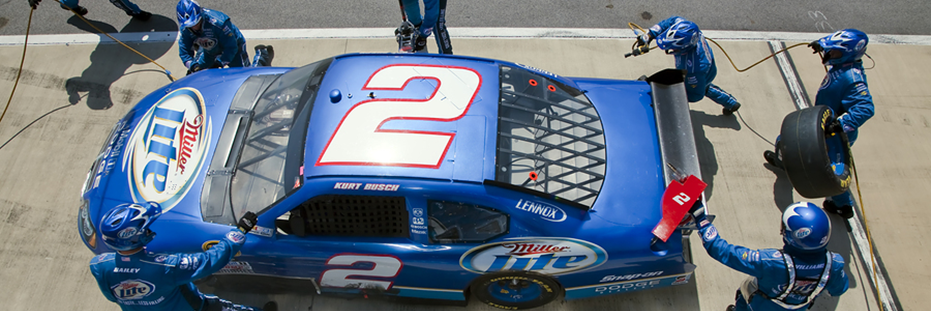
Swift-Teams(sm) exemplify the fusion of proven traditional change- and program-management techniques enabled by agile, collaborative tools and methodologies. Characteristics include: client led; collaborative; solutions driven; visible and transparent; and iterative and adaptive
Change Leadership

Our approach to change is focused on delivering business outcomes and is steeped in practical experience of designing and managing hundreds of initiatives. While implementing change to achieve objectives with speed, predictability and control is complex, the elements summarized in this article are common to most strategic improvement efforts.
Risk Management

As risk is endemic to business, we can never eliminate risk, but we can identify and manage risk through 5 generic approaches to quantified risk: avoid, transfer, mitigate, manage and accept. For project management a convenient frame is to consider the “iron triangle” dimensions (e.g., scope, schedule, cost) as drivers of project risk.
Determine what is most important with the Rapid Assessment Framework

We have developed an objective “root cause” approach to assess enterprise health against a prioritized short-list of 89 critical dimensions each with 4 observable behaviors organized into 14 elements utilizing a browser-based polling/survey technology. The tool is editable for language- and industry-specific vocabulary.
Executive Alignment

Executive teams must provide both the vision for change and “active management” throughout execution. But there must be more. With the explosion of information and the accelerated pace of change in the business environment, decisions must be pushed down in the organization. Noted tools include Execution Roadmap and Decision Map
Responsibility Mapping

This article is a perennial favorite of our site’s visitors. Crisply defined and reinforced roles and responsibilities increase focus, integration and performance. The article defines generic roles for projects, processes, decisions, etc. RACI Framework of: Responsible (the doers); Accountable (the buck stops here); Consult before (see me first); and Inform after (keep me in the loop).
Process Management 101
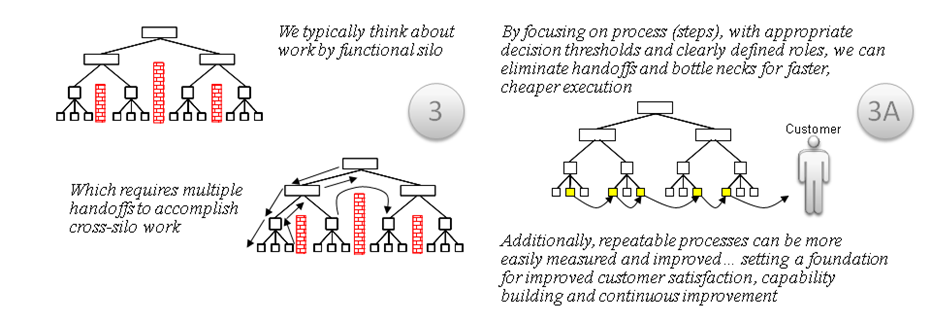
In simple terms all the work, tasks, activity, etc. we accomplish at work, at home, at school, on-line- anywhere- can be thought of as process. A process transforms an input (idea, raw material, information, decision, etc. from a supplier) into an output (good or service for a customer). Beyond definitions, we explore why a process approach is superior to an organizational focus.
Stakeholder Analysis- A Swiss Army Knife for Managers
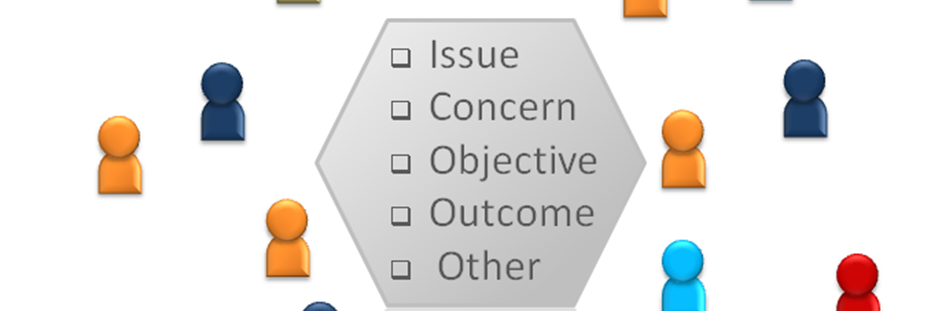
Stakeholder analysis is a great tool to ensure a comprehensive review of those with a stake (e.g., why they care) in those things ranging from the the simple to the complex. We advocate you look for ways to group those with similar-enough needs and preferences, or as the marketers would say segmenting the stakeholders.
Form, Instructions and an Example

After spending days creating an elegant survey instrument, very few people seem to have given much thought to those receiving the request for some of their time. This concept seems to apply to all sorts of data collection, certain types of analysis, or anything which relies on others to complete. Consider including 1) the form, 2) instructions, and 3) an example.
Enterprise View: Collaboration & The Directed Community

During a dicusssion on “how to” best represent collaboration, one of my colleagues simplified the problem as “It’s not about the direction of the information flow, it’s about the number of contributors and the number of information consumers.” So, we began to analyze collaboration as writers (contributors) and readers (information consumers).