
Why hire consultants?

We share a set of practices on “Why hire consultants?” Topics include staff augmentation, perspective, roles, and internal barriers. The article also touches on traditional concerns about consultants, including over-reliance on third-parties to manage mission-critical activities.
Over-Reliance on Outside Resources

Large organizations are more capable at dealing with change than ever before, and they are able to do more of the “work” required of a change program. Yet dependency on outside consultants continues, in part, because of: organizational skill/experience gaps, leadership disengagement, and the expanding role of the consultant
Swift Teams
Swift-Teams(sm) exemplify the fusion of proven traditional change- and program-management techniques enabled by agile, collaborative tools and methodologies. Characteristics include: client led; collaborative; solutions driven; visible and transparent; and iterative and adaptive
Change Leadership

Our approach to change is focused on delivering business outcomes and is steeped in practical experience of designing and managing hundreds of initiatives. While implementing change to achieve objectives with speed, predictability and control is complex, the elements summarized in this article are common to most strategic improvement efforts.
Risk Management

As risk is endemic to business, we can never eliminate risk, but we can identify and manage risk through 5 generic approaches to quantified risk: avoid, transfer, mitigate, manage and accept. For project management a convenient frame is to consider the “iron triangle” dimensions (e.g., scope, schedule, cost) as drivers of project risk.
Pareto’s Lesson on “How”

“While strategic and tactical projects need to be managed with regard for their size and potential impact, both need to incorporate a common, rigorous process for performance improvement that is endorsed by the entire organization…We recognize that the business benefits when it can effectively address both strategic and tactical opportunities within a common framework for change”
Determine what is most important with the Rapid Assessment Framework

We have developed an objective “root cause” approach to assess enterprise health against a prioritized short-list of 89 critical dimensions each with 4 observable behaviors organized into 14 elements utilizing a browser-based polling/survey technology. The tool is editable for language- and industry-specific vocabulary.
Executive Alignment

Executive teams must provide both the vision for change and “active management” throughout execution. But there must be more. With the explosion of information and the accelerated pace of change in the business environment, decisions must be pushed down in the organization. Noted tools include Execution Roadmap and Decision Map
Responsibility Mapping

This article is a perennial favorite of our site’s visitors. Crisply defined and reinforced roles and responsibilities increase focus, integration and performance. The article defines generic roles for projects, processes, decisions, etc. RACI Framework of: Responsible (the doers); Accountable (the buck stops here); Consult before (see me first); and Inform after (keep me in the loop).
Process Management 101
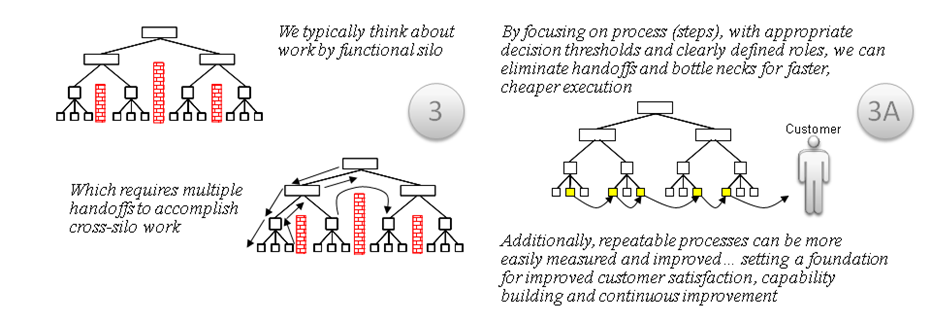
In simple terms all the work, tasks, activity, etc. we accomplish at work, at home, at school, on-line- anywhere- can be thought of as process. A process transforms an input (idea, raw material, information, decision, etc. from a supplier) into an output (good or service for a customer). Beyond definitions, we explore why a process approach is superior to an organizational focus.